For my second presentation for this module I spoke further about the ideas for my project, what I had been researching so far and how I want to continue in the module.
The presentation can be found on Dropbox.
While preparing for this presentation I first reworked my vision statement to better match the direction I was taking with the project:
"To build a showreel of animation, that focuses on performance in acting. To improve my skills as an animator and to develop my animation style."
The showreel being a selection of the animations I do throughout the year in relation to my research. I am still focusing on the performance side of animation, currently exploring acting techniques and referring closely to Ed Hooks' Acting for Animators.
In the presentation I showed off my recent work, the blocking and lip sync clip, then followed that by summing up my exercise on power centres and context in animation.
The feedback was mostly positive with being on the right tracks. I was told to keep focusing on Ed Hooks' Acting for Animators more than the 12 principles.
I was told that I may want to consider a more polished 5 second animation clip in addition to tests and explorations to showcase elements which I have been researching into.
And finally that I should be doing more iterations of things, for example with power centres I should be trying multiple versions of the same power centre, and exploring different results that could be achieved. Iteration is pretty much how the project on the whole is leaning towards: doing something, finding a problem, learning how to fix it, and do it again, etc.
With the second presentation out of the way I can take a more relaxed approach for the next while and hopefully sit down and focus on the animation.
Friday, 5 December 2014

Thursday, 27 November 2014
Blocking and Dialogue
Having tried my hand at lip syncing I wanted to create a more dialogue driven character performance. I've looked at many of The 11 Second Club animations and there are a lot of good examples of how audio clips can be interpreted differently to tell different stories.
Most of the scenes involve characters acting out those scenes where the audio drives how intense their actions are. We all move about when we speak, our hands often act out words we say or actions we describe. We also make subtle movements all across our body, reading body language is a very complex topic. But each animator interprets the audio a little differently which makes for an interesting comparison.
A lot of the animators on the site start off with blocking the actions they want their character to take, Blocking allows you to plan out actions and poses.
The 11 Second Club have a few helpful hints on Why We Block and The Fear of Moving Past Blocking.
With the blocking I wanted to make this character appear as if he's giving advice like a grandfather would. I gave him a stern expression and sharp but not intimidating hand gestures to appear as if he knows what he's talking about. I feel the poses I have do come across well and as I work on this animation further I'll refine the poses where I feel necessary.
Most of the scenes involve characters acting out those scenes where the audio drives how intense their actions are. We all move about when we speak, our hands often act out words we say or actions we describe. We also make subtle movements all across our body, reading body language is a very complex topic. But each animator interprets the audio a little differently which makes for an interesting comparison.
A lot of the animators on the site start off with blocking the actions they want their character to take, Blocking allows you to plan out actions and poses.
The 11 Second Club have a few helpful hints on Why We Block and The Fear of Moving Past Blocking.
This is a work in progress where I try out blocking as well as continue with practising lip syncing. I've blocked out the key poses I want and these are mainly gesturing and body movement that match the words he says.
The lip syncing in this scene is mostly complete, with all the appropriate mouth shapes and timing in that I want. To continue with this I will want to exaggerate some mouth poses so it can be read clearer.
With the blocking I wanted to make this character appear as if he's giving advice like a grandfather would. I gave him a stern expression and sharp but not intimidating hand gestures to appear as if he knows what he's talking about. I feel the poses I have do come across well and as I work on this animation further I'll refine the poses where I feel necessary.
Thursday, 20 November 2014
Animation Context
As a response to my task on power centres, I'd like to concentrate on giving characters a more believable purpose for the actions they are doing.
As an example:
I feel like animating a character running away from something and knocking over some rubbish bins in the process. Rather than just go ahead and animate that, I will give some consideration to the context of that animation within a larger narrative. Some questions that could be asked to inform the animation include:

As an example:
I feel like animating a character running away from something and knocking over some rubbish bins in the process. Rather than just go ahead and animate that, I will give some consideration to the context of that animation within a larger narrative. Some questions that could be asked to inform the animation include:
- Who is he running from?
- Authorities (police).
- What did he do to justify running away?
- Minor crime escalated, police after him.
- How does he feel about that?
- Anxious, guilty, scared.
- Where is he going?
- Nowhere in particular, any location that is safe, the nearest location to escape to and come up with a bigger plan.
- How does all that inform his movement?
- Quicker pace, light steps, eyes darting around, high shoulders/low head
I created a small scene in which I applied these considerations.
Tuesday, 4 November 2014
Power Centres
I've been reading Ed Hooks' Acting for Animators and under his section on insights, perspectives and suggestions he talks about power centres. Everyone has a power centre, an imaginary point around you that leads the way while you walk. While you may not think about it, a power centre says a lot about your personality. A power centre in the chest may suggest pride while a power centre on the floor would suggest a depressed character.
Ed Hooks says "When you give a character a more noticeable power center, it suggests more characterization." It also effects their walking rhythm, a character with a high power centre will walk faster.
I want to animate walk cycles that can really emphasise a character's personality or mood. I think power centres can effect these massively so I gave it a go trying out power centres in front of the nose, in the chest, in front of the feet, and behind the shoulders.
Moving on from this task, I'd like to put a bit more focus into giving the animation context. By that I mean, think about the backstory, why is that character there, what was he doing before and what is his current goal, how does he feel. The audience won't necessarily need to know all this, but by thinking about this and applying it to an animation, the action displayed by that character should be more believable. The audience can then make up their own backstory to that, and if the animation is convincing, then the ideas should be similar.
Ed Hooks says "When you give a character a more noticeable power center, it suggests more characterization." It also effects their walking rhythm, a character with a high power centre will walk faster.
I want to animate walk cycles that can really emphasise a character's personality or mood. I think power centres can effect these massively so I gave it a go trying out power centres in front of the nose, in the chest, in front of the feet, and behind the shoulders.
I let the power centre "pull" the character around. I had to make it feel like their energy was all focused around that imaginary point. I acted out these walk cycles myself to see how my posture was affected when I followed a power centre.
For the first animation I placed the power centre on the floor. Because of this, I made the back arch and slumped which in turn made his head face the floor. As the head was dropped over the power centre, each step he took I made his head bounce.
The end result was basically an obviously depressed or sombre character. As Ed Hooks says, "the higher the power centre, the quicker the rhythm of the character". As this is a low power centre the character walks slower, less confident. He's staring at the ground, and unlikely to make eye contact with anyone in his sight.
In the second animation, I put the power centre in front of the chest. Its higher and so there's a quicker walking tempo and a greater sense of confidence. The character's chin points toward the power centre and as he walks he also has a little bounce in him. His pelvis rotates around the power centre as he walks and moving it a little further down would give him that John Wayne style walk. I made the arm swing greater to emphasise the confidence and almost clumsiness this character seems to possess.
The third animation focuses on a higher power centre, just above and in front of the character's head. The pose overall is that of confidence or snootiness. The character's nose leads the walk and his chest is raised up to point to it. I also made this character raise his knees slightly higher up and increased his walking rhythm.
I felt this exercise has definitely been worth it. Placing power centres in different places makes you think more about the pose and can exaggerate and give character to an otherwise normal walking character. The strongest animation I feel is the low power centre, depressed character. I like the way it allowed me to slump him over and have his body flop up and down on each step. There is more characterisation in this character as it is the most extreme pose out of the 3. The weakest animation was probably the middle power centre one as I feel his character didn't come across as strongly. I think a greater rotation in the waist and a more exaggerated pose would've brought this one up.
I would like to come back to this task at a later date and try different poses with the same power centre and different power centre placements.
Moving on from this task, I'd like to put a bit more focus into giving the animation context. By that I mean, think about the backstory, why is that character there, what was he doing before and what is his current goal, how does he feel. The audience won't necessarily need to know all this, but by thinking about this and applying it to an animation, the action displayed by that character should be more believable. The audience can then make up their own backstory to that, and if the animation is convincing, then the ideas should be similar.
Wednesday, 29 October 2014
Vision Statement
This post is mostly looking at my visual statement in order to refine it to better match the current focus of the project and where I think it will go. The following is copied out from rough notes:
Constructing Vision Statement - Style 1
Constructing Vision Statement - Style 1
- Ideas “Mini projects”
- Animation tasks
- books
- tutorials
- self set
- Problems I want to tackle
Audience: Not sure yet
Constructing Vision Statement - Style 2
Context - What are you doing/creating?
- Series of animations including:
- “Mini projects”
- Animation tasks
- Problems I want to tackle
- Why?
- To improve animation skills.
- To explore how acting in animation conveys an action, narrative or emotion and what techniques are used.
To build a showreel of animations that focus on acting performance, to resin animation to convey an action, narrative or emotion and what techniques are used by others to effectively convey this.
- Performance
- Style
Friday, 24 October 2014
Idiom
We had a lecture that was centred around excerpts from Scott McCloud's Understanding Comics: The Invisible Art, and in particular the six steps to the process of writing comics (which can be applied to art in general).


We were asked to consider our idiom, which McCloud describes as "The 'school' of art, the vocabulary of styles or gestures or subject matter, the genre that the work belongs to... maybe a genre of its own."
Right about now as I go through university I am working upon my craft, learning skills and techniques directly related to what I want to do. What I want to do is create animations, particularly 3D animation. In theory, anybody can put time into learning the skills and technicalities behind animation so considering my work's idiom is important to distinguishing myself. Idiom is its purpose, why am I wanting to animate this? What gives my work identity as opposed to another animator's with a similar level of skill in the craft? What stops me from being "replaceable".
With animation it could be a number of things: the story or subject matter that the animation is trying to convey, the identity of the animation style, the ideas being conveyed through the animation. This is something I am beginning to touch upon and will hopefully realise in the future, hopefully through the help of this project.
Animation Style
Like any other art form, each animator has a style, a way of animating something that makes it there's. Often its through one of the 12 principles of animation. For example Genndy Tartakovsky has a distinct animation style, often focusing on squash and stretch and exaggeration, which gives his animations a comical and elastic feel.
Looney Tunes has such a distinct style, lots of cartoon elements such as stretching, anticipation and over exaggerated action where no-one gets seriously injured. Each of those things contribute towards an animation style and it makes it worth watching, sets it apart from something else.
Animation Content
What is it I'm animating and why is it worth watching. I'd like to think an interesting narrative coupled with good animation is in itself worth watching. The narrative doesn't have to be deep or long, maybe its just something humorous that an audience can relate to.
I like to think I can conjure up some funny animations, they often poke fun at things or are simply a product of a very strange imaginative thought. Throughout university I keep forgetting to return to this idea, the idea that I've always worked towards and that's just entertaining, to get a laugh out of someone.
Sunday, 19 October 2014
Character Performance - Waving
To get to grips with 3D animating I had a go at animating a character waving. I used the Mery rig which is a character with a Disney style aesthetic,
The animation was a simple wave just to learn the ropes of 3D animating. Each limb is controlled with a "control shape" which has attributes such as rotation and translation.
I added anticipation to the wave as the character moves her body outwards before the wave. I also added extra motion to the eyelids as she squints to see someone off-screen, presumably someone she is friendly with (hence the wave) and the smile following the squint.
I'm reasonably happy with this as a first attempt although there are some weird timing going on and there's definitely room for a lot of tweaking and movement of other control shapes to add a more realistic movement to the character on the whole. I may or may not come back to this animation.
Saturday, 11 October 2014
Character Dialogue
One of the things I want to learn is how to animate dialogue and creating believable lip syncing. Although I want to focus mostly on performance, I do think lip syncing will prove valuable to learn.
I'm currently mid-way through this animation but I thought I'd share my progress so far. I've discovered the 11 Second Club, a website where animators create responses each month to an eleven second audio clip from a TV show or movie. The animators then make their own interpretations of that audio, animate and post their results.
I've used the latest competition sound clip to base my lip syncing practice around.

I'm currently mid-way through this animation but I thought I'd share my progress so far. I've discovered the 11 Second Club, a website where animators create responses each month to an eleven second audio clip from a TV show or movie. The animators then make their own interpretations of that audio, animate and post their results.
I've used the latest competition sound clip to base my lip syncing practice around.
At the moment I have the jaw moving for each word in the scene however only have the actual lip syncing done for the first "this device" part.
I've been referencing a mouth shapes diagram created by Preston Blair. I've also started to block out the movement of the character's body.

Friday, 10 October 2014
Presentation Feedback
I presented my Pecha Kucha this week and this post goes over the feedback I received, my personal response to the feedback, and where I want to go next with my research project.
Here is a link to my presentation slides on Dropbox.
The feedback from lecturers gave me a good indication that I was on the right direction with the way I wanted go about my research project. My goal for creating an animated showreel focusing purely on animation was good and I was right to not concentrate too much on writing a narrative or getting technical with rigging.
The idea of using Ed Hooks' Acting for Animators as a good place to start with finding problems I want to tackle and it was suggested looking up on power centres as I noted I was interested in exploring personalities in walk cycles. I will probably do my first research task on this.
Most importantly, it was emphasised the best way to work on this research task was to just do stuff. Only by animating can I discover problems and tackle them.,
There were a few things that I missed out in my presentation that I planned to mention but just got short in time or forgot. Those included conveying humour through actions, particularly slapstick humour and Monty Python style walk cycles. I will also try to do some evaluation blog posts on my previous work, in addition to the work I do throughout this semester.
In regards to the final "end goal" or "vision" I had also considered working towards something to do with the 11 Second Club, perhaps the showreel would be work trying to better myself into then tackling a larger project such as an 11 Second Club competition entry.
So with that in mind I should keep on track with animating stuff and research through practice.
Here is a link to my presentation slides on Dropbox.
The feedback from lecturers gave me a good indication that I was on the right direction with the way I wanted go about my research project. My goal for creating an animated showreel focusing purely on animation was good and I was right to not concentrate too much on writing a narrative or getting technical with rigging.
The idea of using Ed Hooks' Acting for Animators as a good place to start with finding problems I want to tackle and it was suggested looking up on power centres as I noted I was interested in exploring personalities in walk cycles. I will probably do my first research task on this.
Most importantly, it was emphasised the best way to work on this research task was to just do stuff. Only by animating can I discover problems and tackle them.,
There were a few things that I missed out in my presentation that I planned to mention but just got short in time or forgot. Those included conveying humour through actions, particularly slapstick humour and Monty Python style walk cycles. I will also try to do some evaluation blog posts on my previous work, in addition to the work I do throughout this semester.
In regards to the final "end goal" or "vision" I had also considered working towards something to do with the 11 Second Club, perhaps the showreel would be work trying to better myself into then tackling a larger project such as an 11 Second Club competition entry.
So with that in mind I should keep on track with animating stuff and research through practice.
Wednesday, 24 September 2014
The First Step
I've been reading through Ed Hooks' Acting for Animators and think it will be a good start to form mini animation projects on. The book mostly focuses around the performance aspect of animation, applying theatrical acting techniques and adapting them for the animation context.

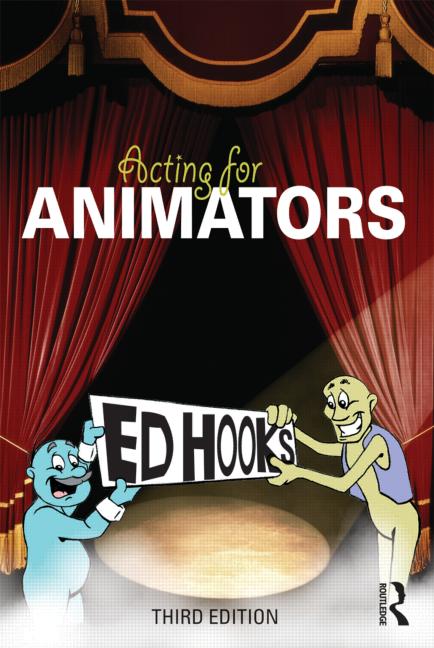
In the book a number of topics are covered, often in small and to-the-point sections. There are a number of techniques, principles and concepts that I may want to research into and animate in response to. This includes animating dialogue, power centres, status transactions, movement and body language. There is also a set of seven essential acting principles which are a bit like Disney's 12 principles of animation but instead focused around performance acting.
In the coming weeks I'll identify which techniques I'd like to talk about, research further into and create work based on the concepts discussed.
Wednesday, 17 September 2014
Starting Point
Creative Research is a module that allows a lot of freedom in choosing what you want to do in order to better yourself in a chosen field or to explore and find the field you want to work in. With such an open brief, its hard to decide where to take the first step. I want to do something along the lines of animation. This semester has allowed me to try 3D animation through the Advanced Animation module and in Technical Arts Application I have been able to learn about the character rigging process.
I've traditionally been a stop-motion animator and have been doing 2D animation during previous years at university. While I enjoyed 2D animation I don't think drawing or character design is my strong point so I'd like to move on from 2D and try my hand at 3D.
I would like to learn how to 3D animate then improve as much as I can with it over the next year. I have a couple of animation books: "The Animator's Survival Kit" and "Acting for Animators" which I may try to use to improve my animations.
In order to work out what Creative Research will be to me, I made this document of notes following our first lecture. It may be completely different by the end of this module or it could turn out to be close to my end goal. Either way, the progress of researching and experimenting will ultimately be the goal itself.
Starting Point
End Goal / “Vision”: To hopefully get a better idea of the field I want to work in. To improve upon things I can do better in, and to develop skills I already have. Hopefully to collate a folio of animation clips that enforces the research I do on other artists in this field.
Create a showreel demonstrating the animation techniques I have learned or improved upon. To back this up with a portfolio of contextual and visual research.
Research:
What I feel I can do well:
What I want to learn:
What I feel I don’t do well on and could improve upon:
This document along with this blog will be used as a reference to the direction I am currently heading. I will update this document through Google Docs.
I've traditionally been a stop-motion animator and have been doing 2D animation during previous years at university. While I enjoyed 2D animation I don't think drawing or character design is my strong point so I'd like to move on from 2D and try my hand at 3D.
I would like to learn how to 3D animate then improve as much as I can with it over the next year. I have a couple of animation books: "The Animator's Survival Kit" and "Acting for Animators" which I may try to use to improve my animations.
In order to work out what Creative Research will be to me, I made this document of notes following our first lecture. It may be completely different by the end of this module or it could turn out to be close to my end goal. Either way, the progress of researching and experimenting will ultimately be the goal itself.
Starting Point
- My field of interest: 3D / stop-motion animation
- Animation in games/film
- Technical art
- currently attending Advanced Animation and Technical Art Applications, siding more with Advanced Animation but enjoy the technical side of animating, such as the principles of animation.
End Goal / “Vision”: To hopefully get a better idea of the field I want to work in. To improve upon things I can do better in, and to develop skills I already have. Hopefully to collate a folio of animation clips that enforces the research I do on other artists in this field.
Create a showreel demonstrating the animation techniques I have learned or improved upon. To back this up with a portfolio of contextual and visual research.
Research:
- To explore acting through animation (poses, actions)
- Life drawing - same pose from multiple angles to help determine volume, shape.
- Film and use reference footage to study weight/volume shifts.
- Use and research principles of animation to make actions seem more fluid/life-like.
- Pacing - how to plan ahead for an action, develop techniques for where to place an object in relation to its motion (i.e. its speed, acceleration).
- Look at other animators and their processes.
What I feel I can do well:
- Use a 3D computer model, or stop-motion model to animate with.
- The facility of having a model which you can ‘reset’ its volume or shape is for me, easier to work with than 2D animation
- Analyse 2D animation and how principles are used.
What I want to learn:
- Scripting, in order to speed up laborious tasks, increase realism and fluidity, or to exaggerate a more “cartoony” character.
What I feel I don’t do well on and could improve upon:
- Drawing 2D characters
- Techniques in Flash in order to animate efficiently
This document along with this blog will be used as a reference to the direction I am currently heading. I will update this document through Google Docs.
Subscribe to:
Posts (Atom)